
Hotmelt Insulated Glass Sealant
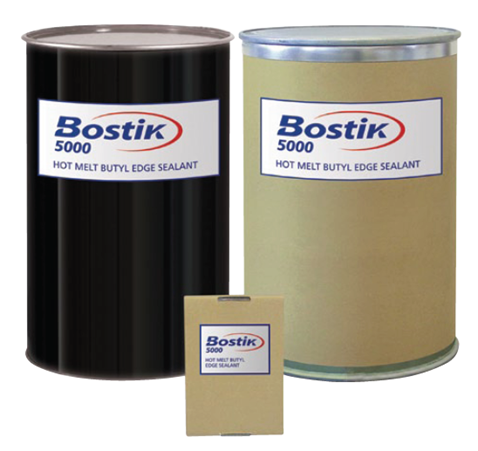
Bostik 5000 is a premium hot melt butyl sealant developed using over 30 years experience of hot melt technology in IGU manufacture. It is the current market leader in Europe and fully complies with both the US/Canadian standard ASTM E 2190, Higs and the European standard EN 1279 Parts 2,3,4 & 6.
Application Characteristics :
The application characteristics of Bostik 5000 have been designed to be versatile and meet the typical requirements of hand gunning, robotic application and automated lines. These include:
- No Stringing
- No Aeration
- Minimal Odor
- Low Tack
- Fast Set up
- No Slumping
Excellent Movement Accommodation
All IGUs expand and contract across a wide temperature range. It is important a sealant can accommodate this movement otherwise significant stress is put on the glass/sealant interface, resulting in a gradual deterioration of the adhesive bond. Unlike competitor products Bostik 5000 is designed to extend up to 290% before failure, ensuring the seal is maintained during expansion/contraction of the unit (see below).
Low Temperature Flexibility
In colder climates IGUs will be exposed to particularly low temperatures, and it is critical the sealant maintains a degree of flexibility under these conditions. In cold bend tests Bostik 5000 remains flexible down to -35°C (-31°F), outperforming competitor products. In addition to flexibility at low temperatures it is equally important the adhesive bond remains intact in the cold. Bostik 5000 demonstrates excellent performance in cold slam tests of IGUs, designed to induce delamination of glass panes at low temperatures.
Bostik 5000 maintains the adhesive bond down to -72°C (-98°F) even when it has gone rigid and compares well with competitor products, including reactive hot melts.
Low Gas Permeability
With the demand for increasingly thermal efficient IGUs, gas filled units are becoming more prevalent. To meet these requirements, bostik 5000 has been developed with an extremely low gas permeation rate through the sealant. In addition, the excellent movement accommodation ensures that the seal is maintained during the lifetime of the unit, further preventing gas loss. This retention of the gas during the lifetime of the IGU ensures the high thermal performance of an IGU far longer.